7 Expert Tips for Choosing an Easy-Care Luxury Sofa Bed
7 Expert Tips for Choosing an Easy-Care Luxury Sofa Bed
Home Comfort Decisions
At Home Comfort Decisions, we help you buy once. Our spec-first approach compares sleeper sofas by mechanism, mattress, upholstery performance, real-world dimensions/clearances, and retailer policies so you avoid returns and choose a luxury sofa bed for everyday use that’s truly easy to maintain. A sofa bed is a sofa that conceals a bed inside its frame, providing dual seating and sleeping functionality for compact living and hosting, as outlined in Feather & Black’s guide to luxury sofa beds (what to consider with luxury sofa beds: https://www.featherandblack.com/inspiration/what-to-consider-with-luxury-sofa-beds). We also publish neutral comparisons for small-space multifunctional furniture like storage beds/frames and extendable console tables, plus retailer and policy comparisons and sizing/mechanism checklists. If you’re searching for the best sleeper sofas for daily use, the seven tips below will help you shortlist options that perform without constant upkeep.
Define your use case and sleep frequency
Start by matching the product to how it will really be used. Sleep frequency is how often the sofa bed is used for overnight sleep; it shapes the required mattress type, frame build, and conversion effort. Editor testing shows that many sleepers with pull-out mattresses are engineered for more regular use than basic futon-style sofa beds, a nuance Architectural Digest emphasizes in its hands-on roundup (the very best sleeper sofas, tested: https://www.architecturaldigest.com/story/the-very-best-sleeper-sofas-tested-and-reviewed-by-our-editors).
Use this quick selector:
- Nightly or weekly: prioritize a thicker hybrid or high-density foam mattress, a robust metal/steel frame, and a single-motion conversion mechanism.
- Occasional/guests: thinner mattresses can be acceptable if footprint and design are top priorities.
- Mobility or limited storage: consider clic-clac/daybed or powered/touch-glide styles for low-effort conversion and less lifting.
Prioritize mattress type and thickness
Mattress specs drive real sleep comfort—and how much care is required later. On traditional metal pull-out mechanisms, mattresses are typically about 3.5–5 inches thick; by contrast, foam-on-floor or platform sleepers often reach 7–8 inches and feel plusher for nightly use, per Architectural Digest’s testing insights. If you expect frequent sleep, check for upgrade paths: many luxury models offer pocket-sprung cores or memory foam upgrades, and some list pocket-sprung bases around 12 cm with memory foam options, noted in GQ’s expert roundup (best sofa beds picks and specs: https://www.gq-magazine.co.uk/lifestyle/gallery/best-sofa-beds).
Mattress comparison at a glance:
| Mattress type | Typical thickness range | Feel and support | Breathability/temperature | Maintenance notes | Notable example/spec |
|---|---|---|---|---|---|
| Memory foam | 4–8" | Conforming pressure relief; motion-dampening | Can sleep warmer unless ventilated foams used | Rotate head-to-foot; protect with breathable cover | Waterlily viscoelastic 6.3" is described as breathable, antibacterial, and ergonomic by SofaBed.com (luxury sofa beds feature rundown: https://www.sofabed.com/blogs/reviews-and-comparisons/best-luxury-sofa-beds) |
| Pocket-spring | 4–7" | Buoyant, supportive; better airflow than solid foams | Good airflow through springs | Check edge support; rotate periodically | Common upgrade in luxury sleepers; often cited at ~12 cm bases |
| Hybrid (springs + foam/viscoelastic) | 6–8" | Balanced contour + support; reduces bar feel | Varies by foam blend and cover | Minimal; rotate and use protector | Often the most comfortable for nightly use on platform bases |
Pro tip: If you love a slim, elegant sofa profile but need nightly comfort, target a platform/bench-fold design that allows 7–8 inches of mattress rather than a thin pull-out pad.
Choose a robust frame and proven mechanism
Longevity starts under the upholstery. Steel frames are prized in premium sofa beds for being lightweight yet sturdy, and some brands back them with long warranties—a 25-year steel frame warranty is a strong durability signal, according to King Living’s buying guide (sofa bed buying guide with frame and warranty insights: https://www.kingliving.com/blog/sofa-bed-buying-guide).
A sleeper mechanism is the hardware that transforms a sofa into a bed (e.g., pull-out, two-fold, clic-clac), determining conversion effort, mattress thickness capacity, and parts wear. When in doubt, favor simple, widely used actions with solid parts availability—such as a two-fold mechanism. For aesthetics and floor clearance, some premium “high-leg” or “rare action” systems hide the bed seamlessly; examples like Sedac 2-fold mechanisms and high-leg rare-action designs are profiled by The Sleep Co. (mechanism and model spotlights: https://thesleepco.com/blogs/news/luxury-sofa-bed).
Select easy-clean, durable upholstery
You want fabrics that shrug off spills and abrasion without looking like performance gear. Velvet can deliver a luxe look and rich color, but it generally needs gentler care than performance weaves, as GQ’s editors note in their buying advice. For the lowest maintenance, target:
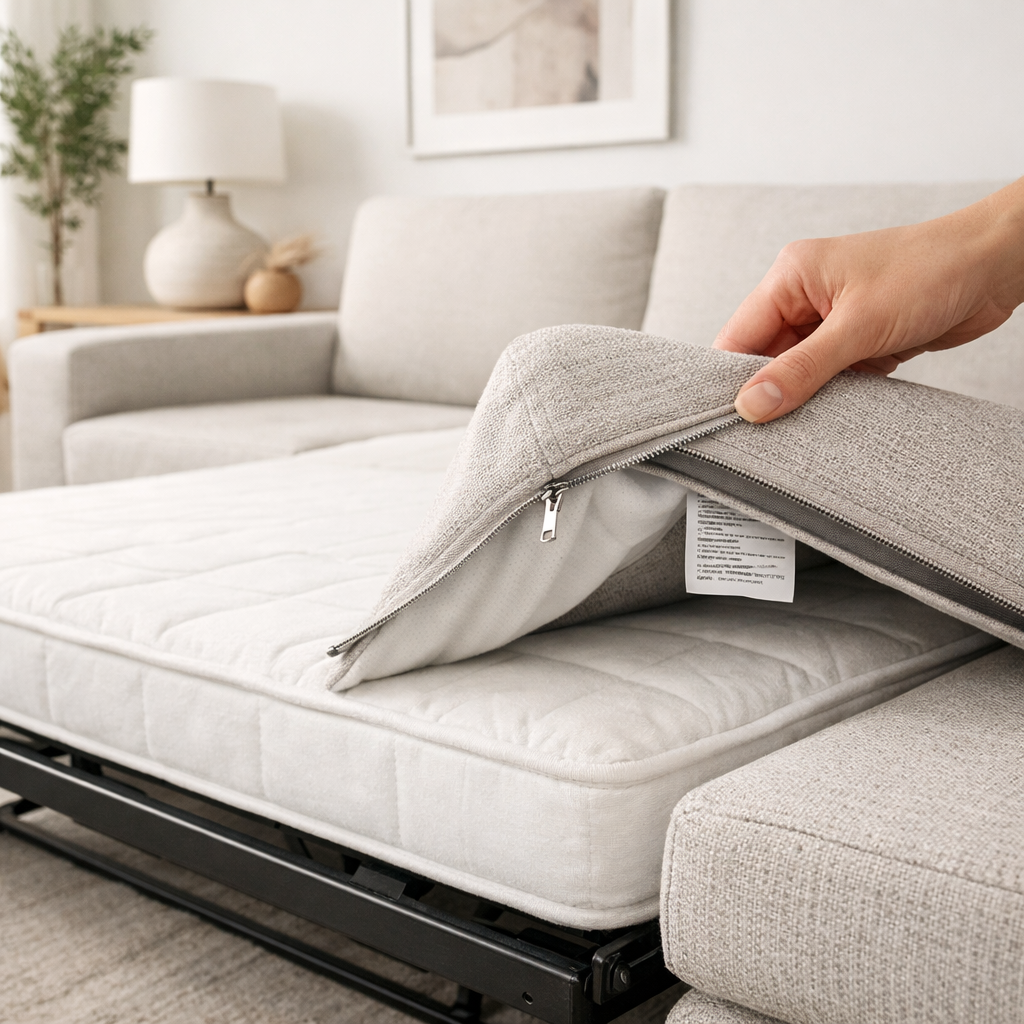
- Performance fabric sofa bed options (solution-dyed or high-performance weaves) with stain resistance and removable, machine-washable covers.
- 100% top-grain leather for a luxury, wipe-clean surface paired with easy-open mechanisms (commonly cited on premium models by SofaBed.com).
- Swappable/zip-off cushion covers to quickly address stains, allergens, and pet hair.
Compare at a glance:
- Performance fabric with removable covers: best for families, rentals, and pets.
- Velvet: elevated look; accept higher care needs and more visible pile marks.
- Top-grain leather: easiest wipe-down; typically fewer color/texture options.
Verify conversion ergonomics and space clearance
Make sure the opening action matches your mobility and room. Common sofa-bed types to test include pull-out, clic-clac, futon, and daybeds, as outlined by Feather & Black. Before you buy:
- Watch the brand’s video and count steps to convert (closed-to-open-to-closed).
- Gauge effort: can one person open it? Is one-hand operation realistic?
- Check where bedding lives: is there integrated pillow/blanket storage?
- Note powered benchmarks: some systems, like TouchGlide-style designs, convert at the touch of a button (referenced by King Living), which can help in tight or high-traffic spaces. Home Comfort Decisions’ checklists standardize these ergonomics checks so you can compare models quickly.
Clearance checklist:
- Front pull length (so the bed can fully extend without hitting a coffee table).
- Side swing room for arms/chaise and any ottoman modules.
- Wall clearance behind the back when reclining or unfolding.
- Rug drag risk and floor protection during conversion.
Right-size the footprint and the open bed
Measure for the home it must travel through and the space it must serve. Clearance depth is the distance required in front/behind/side to fully open the bed, including mattress overhang and leg angle. Write down:
- Closed sofa dimensions (W × D × H) and the open bed size.
- The exact pull length to open and any recline/swing clearances.
- Hallway, elevator, and stair-turn dimensions to confirm delivery feasibility.
Hosting frequently? Choose queen/king for adult guests and taller sleepers; full/twin can be ideal for urban flats and occasional overnights. Measuring the pull-out space in advance avoids conversion surprises later.
Add small-space features that simplify upkeep
Smart features reduce daily friction. Many sleeper sofas include base storage sized for bedding and blankets—handy for compact apartments and quick resets between guests, as noted in the New York Post’s sleeper sofa roundup (roundup noting storage features: https://nypost.com/article/best-sleeper-sofas/). Prioritize:
- Hidden storage bays and pillow garages to keep linens dust-free.
- A modular chaise with reversible orientation to adapt to tight layouts.
- Pocketed cushions or zip-off covers to speed cleaning; some family-focused designs add chaise and pillow storage (e.g., Bonbon Comfy Lux-style builds). We flag these features in our model comparisons so maintenance stays simple day to day.
Balance customization, lead times, and total landed cost
Bespoke fabrics, leathers, and mattress upgrades can extend lead times and raise prices. Expect made-to-order luxury sleepers to start in the mid-$3,000s and climb into the $5,000+ range, according to Style by Emily Henderson’s recent roundup (price context for comfortable sleepers: https://stylebyemilyhenderson.com/22-comfortable-sleeper-sofas).
Total landed cost is the all-in price to own the sofa bed—product, fabric/mattress/mechanism upgrades, delivery and assembly, returns/exchanges, haul-away, and warranty coverage. Home Comfort Decisions uses this framework to compare like-for-like across retailers so you see the true cost upfront.
Budget worksheet:
| Cost item | Estimate/notes | Add to cart? |
|---|---|---|
| Base sofa bed price | Size/mechanism tier | |
| Fabric/leather upgrade | Performance fabric or top-grain leather | |
| Mattress upgrade | Pocket-spring or memory foam/hybrid | |
| Mechanism upgrade | Two-fold/high-leg/powered | |
| White-glove delivery | Room-of-choice, assembly, packaging removal | |
| Stair/elevator surcharge | Per flight or per attempt | |
| Haul-away of old sofa | If needed | |
| Return/restocking fee | Custom orders often non-returnable | |
| Lead time | Weeks from order to delivery |
Quick mechanism and sizing checklist
Mechanism:
- Action type chosen: pull-out, two-fold, clic-clac, or daybed. Steps to open confirmed. One-hand feasible?
- Mattress thickness supported meets your target (≥6" for frequent sleep; 7–8" typical on platform foam designs).
- Frame material and warranty length verified (steel + long warranty preferred).
Sizing:
- Closed W × D × H fits room; door/elevator/stair path verified.
- Open-bed length/width fits guest height; front pull clearance measured.
- Rug/floor protection plan set; wall and side clearance confirmed.
Retailer service, delivery, and warranty policies
Reduce friction by confirming:
- Frame/mechanism warranties (seek long coverage on steel frames), in-home service scope, and replacement availability for covers/cushions.
- Delivery level (white glove), stair carries, packaging removal, assembly, haul-away, and damage/defect claim windows.
- Returns/exchanges: restocking fees, custom/non-returnable rules, timelines, and who handles reboxing and pickup. Home Comfort Decisions maintains retailer policy comparisons and scorecards to help you verify these details before purchase.
Notable models to benchmark
These are neutral benchmarks for features and price positioning—use them to calibrate expectations, not as endorsements:
- Shabby Chic 18 Luxury Sofa Bed — removable covers and 18 cm mattress; ~£1,418; feather or hypoallergenic fills available.
- Sofia Sofa Bed — streamlined silhouette with supportive mattress and custom fabric options for tailored looks.
- Bonbon Comfy Lux — 18 cm mattress, 20 cm arms, optional chaise-longue, plus pillow storage for family setups.
- Riana (High Leg Action) — premium high-leg “rare action” mechanism; ~£2,039; anticipate longer lead times.
- Jessica Sedac 2 Fold — British-crafted aesthetic with Sedac 2-fold simplicity; starts ~£1,239.
- Pompea Luxury Leather Maxi — 100% top-grain leather, easy-open action; Waterlily viscoelastic 6.3" mattress option highlighted for breathability and antibacterial properties.
- Sundays Sleep Over — a frequently cited comfort-and-conversion benchmark in recent buyer’s guides (see Dweva’s comparison: https://dweva.com/blogs/buying-guide/the-best-sleeper-sofas).
Frequently asked questions
How do I choose the right size and mechanism for my space?
Measure the closed footprint and full pull-out depth, then match a simple, single-motion mechanism to your mobility and storage needs. Home Comfort Decisions’ sizing and mechanism checklists make the trade-offs clear.
Are thicker mattresses always more comfortable on sofa beds?
Thickness helps, but construction matters more. Foam-on-floor/platform sleepers with 7–8" mattresses typically feel plusher than 3.5–5" metal pull-outs, and quality foam or pocket springs can outperform a thicker but lower-grade pad.
Which upholstery is easiest to maintain without looking utilitarian?
Performance fabrics with removable covers or top-grain leather balance easy cleaning with a premium look. Home Comfort Decisions’ fabric guidance favors stain resistance, washability, and longevity without a utilitarian feel.
What policies should I confirm before ordering a luxury sofa bed?
Confirm warranty length, delivery/assembly details, return/restocking terms, and availability of replacement covers. Home Comfort Decisions’ retailer policy comparisons can help you verify the fine print.
Can a mattress topper fix an uncomfortable sofa bed?
A topper can soften surface feel but won’t fix thin pull-out mattresses, bars, or uneven platforms. For frequent sleep, start with the right mechanism and a higher-spec mattress using Home Comfort Decisions’ spec filters.