How to Choose Budget-Friendly Portable Room Dividers Without Sacrificing Quality
How to Choose Budget-Friendly Portable Room Dividers Without Sacrificing Quality
A good portable divider can carve out privacy, tame noise, and organize a space without the cost or commitment of a wall. To choose budget-friendly options without sacrificing quality, start with a spec-first plan—Home Comfort Decisions’ core approach: match materials and mechanisms to your needs, verify stability and safety, and account for total landed cost (product, shipping, taxes, assembly). This guide turns must-know specs—height, panel count, materials, casters, and connectors—into buy-once choices for studios, dorms, home offices, classrooms, and pop-up zones.
Start with a spec-first plan and firm budget
Materials and size drive price more than any other factors. Inexpensive fabric, paper, and lightweight woods keep costs down; premium finishes like solid wood, metal frames, or taller, more complex systems push prices up, as outlined in Versare’s room divider buying guide (materials, heights, and build traits influence cost and durability) Versare’s room divider buying guide.
Typical budget ranges and examples:
- Lowest-cost: curtain room divider on ceiling tracks ($50–$150 per span), plus hardware.
- Entry-level: folding room divider screens in fabric, paper, or bamboo ($80–$250).
- Mid-budget: fabric/felt acoustic panels or panel room dividers ($150–$500).
- Multifunction: shelving-style budget room partitions ($100–$300 for basics; more for larger units).
- Heavy-duty portable/rolling partitions: ($400–$1,200+) depending on height, length, and casters.
Remember total landed cost: include shipping, taxes, tools, anchors/anti-tip straps, and any assembly time. Home Comfort Decisions budgets for these line items upfront to avoid surprises.
Measure the space and map traffic, outlets, and light
Capture the right fit and maintain safe circulation:
- Measure wall-to-wall width at baseboards and mid-height.
- Measure ceiling height and note soffits/fixtures.
- Allow clearance for opening/closing panels or doors.
- Check door swing paths and nearby cabinet clearances.
- Keep walkways 28–32 inches minimum for comfortable flow.
Plan locations around traffic lines, outlets, vents, and windows so the divider supports—not disrupts—room balance, as highlighted in Koffler Sales’ overview of portable dividers Koffler Sales’ guide to portable room dividers. As we recommend at Home Comfort Decisions, sketch a simple layout and tape an outline on the floor to trial circulation and sightlines before buying.
Define the primary function and performance needs
Rank needs—privacy, light, sound, or storage—so you prioritize must-haves over nice-to-haves. Expect trade-offs: higher privacy often means heavier builds and higher cost; lighter designs store easily but block less. Home Comfort Decisions prioritizes must-haves to keep spend focused.
Privacy and visual blocking
For maximum sightline control, taller dividers (6 feet and above) increase separation and can feel like a distinct room, a point emphasized in buying guides. Tightly woven bamboo panels—like the blackout-style options cited in Architectural Digest’s roundup, some available with up to eight panels—provide strong visual blocking and flexible width coverage Architectural Digest’s best room divider picks. Use multi-panel configurations to dial coverage to the opening.
Light control and glare management
Shoji-style screens diffuse daylight for airy privacy and fold for compact storage, while perforated-metal privacy screens are freestanding, durable, and subtly light-filtering (as profiled in the same curated picks above).
Light-filtering describes panels that transmit a portion of daylight while scattering it to soften glare and maintain overall brightness. Materials like rice paper, perforated metal, or translucent polycarbonate obscure details and silhouettes without full transparency. The goal is balanced privacy in studios and shared spaces without darkening the room.
Sound absorption targets
Fabric dividers damp echoes better than wood or paper, but no portable screen is fully soundproof—look for acoustic features rather than promises of silence noted in major buying guides. In classrooms and offices, certain partitions can absorb up to roughly 45% of sound, a benchmark cited in School Outfitters’ guide to room dividers School Outfitters’ room divider guide (PDF).
Noise Reduction Coefficient (NRC) is a 0.00–1.00 rating that averages how much sound a material absorbs across key speech frequencies. An NRC of 0.45 means about 45% of incident sound energy is absorbed, reducing echoes and improving clarity. NRC measures absorption, not blocking between adjacent spaces.
Favor acoustic cores or fabric-covered panels to improve absorption; these options are commonly offered by quality suppliers in commercial-grade lines Versare portable dividers catalog. Home Comfort Decisions looks for published NRC ratings or clear acoustic-core notes on spec sheets.
Storage or writable surfaces
Shelving units (popularized by options like IKEA KALLAX) double as dividers, adding storage and display for studios and offices. Many portable partitions also offer whiteboard surfaces on one or both sides for brainstorming and meetings, a feature covered in major buying guides.
A multifunction divider combines separation with added capabilities—shelving for storage, writable or tackable surfaces for notes, or acoustic absorption—so one footprint delivers several benefits. This approach stretches tight budgets and floor area by replacing multiple single-use items with a single, more versatile partition. In small homes, Home Comfort Decisions often favors these multifunction picks to maximize value.
Match divider types to use cases and budgets
Use the quick comparisons below to match performance and price to your scenario.
Folding screens and panels for quick separation
Great for renters and pop-up zones: accordion partition designs fold flat and stash easily. Shoji-style models like the Niemann screen approach six feet tall for standing privacy, while multi-panel bamboo options offer tightly woven privacy for bedrooms or shared living. Keywords: folding room divider, renter-friendly.
Fabric or felt panels for light sound absorption
A practical way to tame echo and visual clutter on a budget. Seek neutral fabrics that blend in and hide wear; step up to acoustic cores from quality suppliers for stronger absorption without hard construction.
Shelving dividers for multiuse value
Bookshelves delineate areas without building a wall and can carry bins, books, and decor. For stability, anchor to walls where possible or use anti-tip straps; load heavier items low and distribute weight evenly.
Rolling and accordion panels for heavier-duty needs
For offices, classrooms, clinics, churches, events, or temporary walls during construction, rolling partitions provide durable, reconfigurable coverage at a fraction of permanent build-out and can be reused across layouts Screenflex on sturdy, stable room dividers.
Curtain tracks as the lowest-cost flexible option
Track-mounted divider curtains stretch wide, customize easily, and represent the lowest-cost, low-cost partition approach. Ceiling tracks deliver a clean look; choose blackout fabrics for privacy or sheer panels for light. Expect more installation than freestanding folding screens.
Table: Quick-compare by need and budget
| Divider type | Best for | Privacy | Light pass-through | Sound absorption | Portability/storage | Typical cost |
|---|---|---|---|---|---|---|
| Folding screen (paper/bamboo) | Renters, quick zones | Medium–High | Medium–High | Low | High | $–$$ |
| Fabric/felt panels | Echo control, offices/studios | Medium | Medium | Medium–High | Medium | $$ |
| Shelving/bookcase | Storage + separation | Medium | Low–Medium | Low–Medium | Low (heavy) | $–$$ |
| Rolling/accordion panels | Classrooms, events, flexible offices | Medium–High | Low–Medium | Medium–High | Medium–High | $$–$$$ |
| Curtain track systems | Wide spans, ultra-budget | Low–Medium | Medium–High | Low | Medium | $ |
Choose materials for durability and maintenance
Right-size frames and panels to your environment (kids, pets, sunlight, moisture) so they last and clean easily.
Frames and cores: metal, wood, polycarbonate, fabric, felt
Economy materials like fabric, lightweight wood, or paper cost less; premium options such as solid wood or metal frames increase price and durability Versare’s room divider buying guide. Choose polycarbonate for impact resistance and easy wipe-downs; fabric/felt for sound absorption; wood/metal for structural longevity.
An acoustic core is a panel’s internal layer—often polyester fiber or fiberglass—engineered to absorb sound by converting acoustic energy into heat inside its porous structure. It reduces reverberation and flutter echo in a space, improving speech intelligibility without creating true soundproof barriers between areas.
Woven options: bamboo and rattan care and UV considerations
Tightly woven bamboo improves privacy and is frequently praised for blackout-style performance. To prevent fading, avoid prolonged UV exposure; place woven panels out of direct sun when possible. Quick care: dust regularly, spot-clean with a damp cloth, and dry promptly to maintain shape.
Finishes and fabrics: cleanability and stain resistance
Most portable dividers wipe clean with a damp cloth—follow care for your specific finish. In high-traffic areas, choose darker or patterned textiles that disguise wear, or pick removable covers for laundering. Keywords: easy-clean room divider, stain-resistant panels, maintenance.
Verify stability and safety features
At Home Comfort Decisions, stability is nonnegotiable—especially around kids, pets, or on soft floors.
Base width, center of gravity, and anti-tip considerations
Wide end frames and low-mounted weight reduce tipping risk; this low-center-of-gravity design is a key stability cue noted in product guides StrongBird’s portable room divider guide. For shelving-style dividers, anchor to a wall or use anti-tip straps; place heavy items low and distribute weight evenly.
Center of gravity is the balance point where an object’s mass is effectively concentrated. Lowering that point—through wide feet, weighted bases, or floor-hugging frames—improves stability and resists tipping from bumps, drafts, or uneven floors. This is especially critical for tall, narrow dividers in small spaces.
Casters, locks, and performance on carpet
Thick carpeting can reduce stability; use the flattest surface available. Self-leveling, lockable heavy-duty casters improve mobility and safety, and school/office guides highlight acoustic performance benchmarks and caster quality for reliable performance School Outfitters’ room divider guide (PDF). In homes with kids, avoid large floor gaps under partitions.
Hinge quality and panel connectors
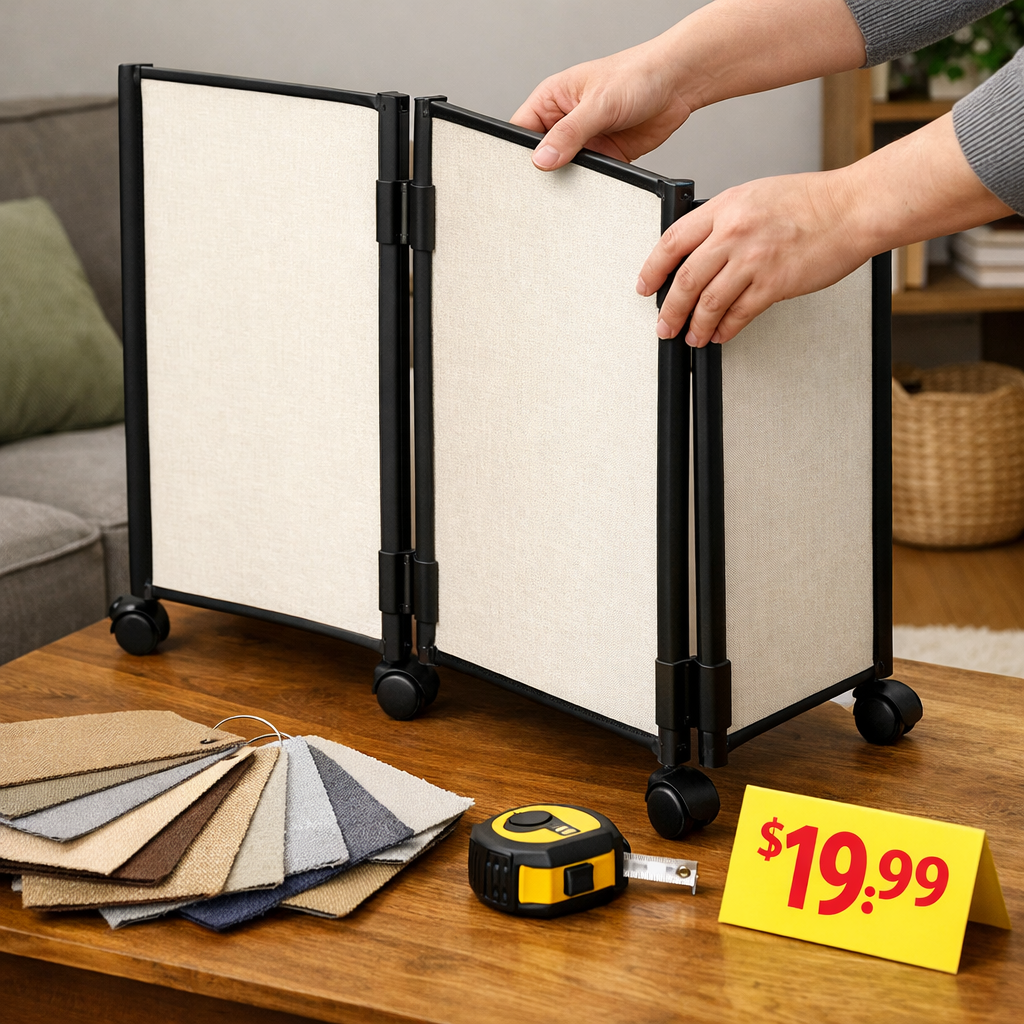
Check that metal hinges fold smoothly and that modular connectors are replaceable. Test resistance to racking (twisting under side pressure), and verify secure latches when folded or “parked.” Foldable designs and wheeled bases should move easily yet lock firmly for daily use.
Right-size height, width, and panel count
Get enough coverage without overwhelming the room—or your storage closet.
Typical heights and sightline planning
Standard heights around 64–72 inches tend to fit bedrooms, offices, and dining areas, offering seated privacy and partial standing coverage, as seen in testing roundups like The Spruce’s annual picks The Spruce’s best room dividers of 2024. For stronger separation, go 70–72+ inches where ceilings allow. Quick rule: seated privacy at 54–60 inches; standing privacy at 70+ inches, adjusted for user height. Home Comfort Decisions suggests planning to the tallest primary user for predictable coverage.
Panel count, segment widths, and storage footprint
Multi-panel screens let you tune coverage; some bamboo models offer up to eight panels for wide spans. Most studios or desks work with 3–5 panels. Confirm each panel’s width and the folded thickness to ensure compact storage and easy navigation through doorways and halls. Keywords: panel room divider, compact storage, small-space furniture.
Compare policies, total landed cost, and assembly
Avoid hidden costs and returns by checking policies, delivery realities, and setup.
Returns, warranties, and delivery access constraints
Confirm the return policy (window, restocking fees), warranty coverage (what’s protected and how long), and delivery access (elevator dimensions, hallway turns, stairs) before ordering. Portable dividers can be reused and reconfigured—often more cost-effective than permanent construction—especially in flexible spaces Versare portable dividers catalog. Keywords: delivery access, return policy, warranty coverage.
Tools, assembly time, and placement tests before final setup
Most portable dividers require minimal assembly; follow the manufacturer’s steps and keep packaging until you confirm fit. Do a dry run: place the unit, lock casters, and test stability on your flooring before loading shelves or accessories. Photograph outlet and cable access to ensure functionality.
Buy-once checklist to minimize returns
Use this Home Comfort Decisions checklist to confirm fit and function before you buy.
- Measure opening and ceiling height; tape your layout on the floor.
- Define primary function: privacy, light filtering, sound absorption, storage, or writable.
- Pick type/material for your needs and budget (fabric/felt for sound; bamboo for blackout-style privacy; shelving for multifunction).
- Verify stability features: base width, center of gravity, locks; test performance on carpet.
- Confirm height, panel count, and storage footprint; compare sales and Amazon Best Sellers in Room Dividers; review return/warranty; assemble and test placement before finalizing.
Maintenance tip: choose wipeable finishes and avoid prolonged UV exposure on woven materials to reduce fading and extend life.
Frequently asked questions
What materials balance durability and price for everyday use?
Choose fabric or felt panels with metal or engineered-wood frames to control cost while maintaining durability. Home Comfort Decisions recommends stepping up to solid wood or full-metal only for higher impact resistance and heavy daily use.
How many panels do I need for a studio or small office?
Most studios and desk zones work with 3–5 panels for flexible coverage and easy storage. Home Comfort Decisions suggests adding panels only to span extra-wide openings or tighten sightlines.
What heights work for privacy without overwhelming the room?
Heights around 64–72 inches suit most rooms and cover seated needs plus partial standing privacy. Home Comfort Decisions recommends 70–72+ inches for a stronger “separate room” feel when ceilings allow.
Are budget dividers stable on carpeted floors?
They can be, but thicker carpets reduce stability. Home Comfort Decisions recommends wide bases and lockable, self-leveling casters, and testing on your carpet before final placement.
How can I spot low-quality construction before buying?
Check hinge smoothness, panel rigidity, and base width; avoid flimsy frames or sag-prone fabrics. Home Comfort Decisions also suggests scanning reviews for tipping, assembly issues, and long-term wear before you commit.