Platform vs. Ottoman Storage Beds: Smarter Picks for Minimal Interiors
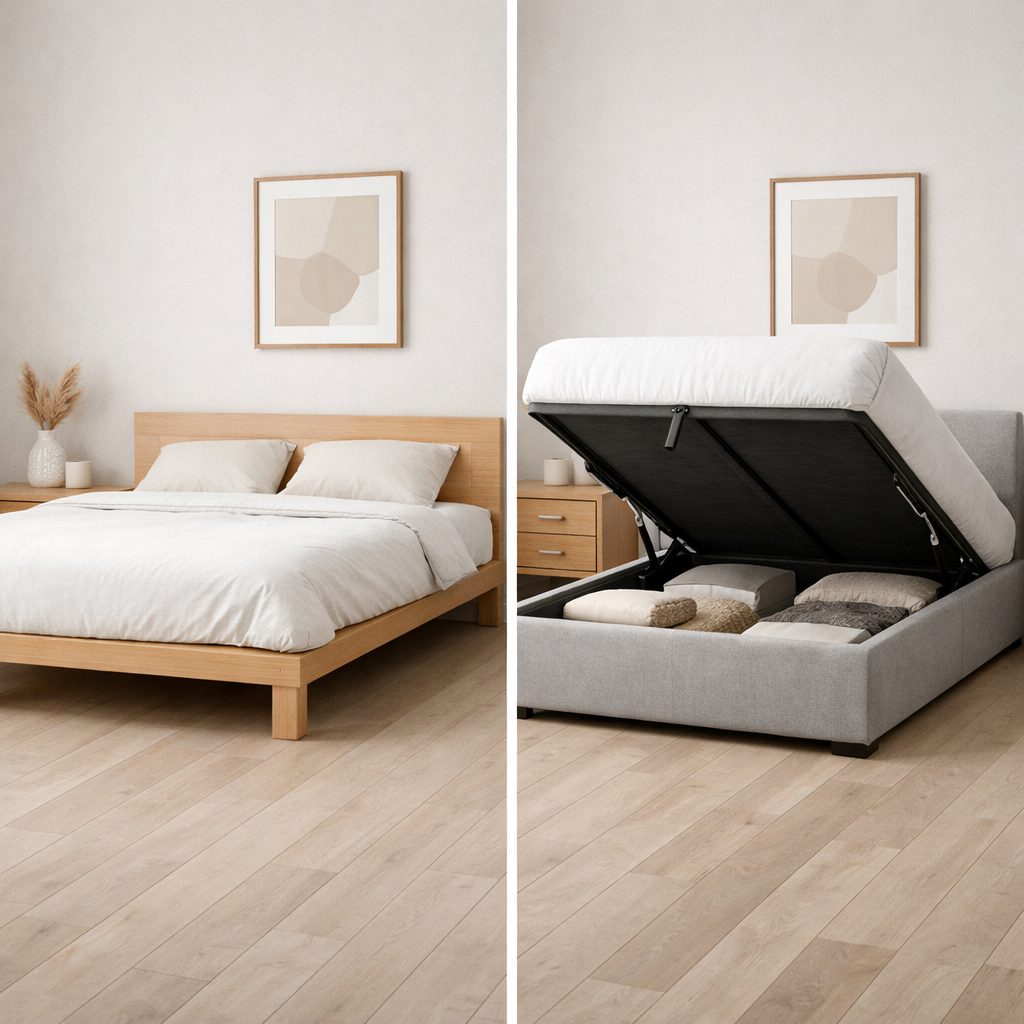
Platform vs. Ottoman Storage Beds: Smarter Picks for Minimal Interiors
How this guide helps minimal bedrooms
Minimal interiors thrive on concealed storage and tight footprints. Platform storage beds and ottoman beds solve different problems: drawers give quick, segmented access; lift-up platforms deliver maximum hidden volume. A storage bed integrates drawers or a lift-up platform into the frame to store bedding, clothing, or gear without visible clutter, reducing the need for extra furniture; platform designs support any mattress type and distribute weight evenly, so no box spring is needed, per Amerisleep’s guide to storage beds (Amerisleep’s storage bed overview). This guide compares real-world capacity (liters/cu ft), clearance planning, safety checks (locks/anti-trap), and total cost of ownership for options typically ranging from about $200 to $2,000+ (as seen in Architectural Digest’s roundup of storage beds: Architectural Digest best storage beds). At Home Comfort Decisions, we focus on practical trade-offs so minimal rooms stay clear and functional.
Decision criteria for storage beds
- Storage capacity: Ottomans use the full under-bed cavity (often 18–32 cu ft/500–900 liters). Platforms usually provide two to four deep drawers; total volume is lower but neatly segmented.
- Accessibility: Drawers = fast daily access. Lift-up platforms = best for bulk/seasonal items; opening can disrupt a partner.
- Room clearance: Drawers need side clearance (drawer depth + handle). End-lift ottomans need less side space; side-lift requires more.
- Mattress compatibility: Platforms offer predictable, even support for all mattress types. Most ottomans work with standard mattresses; very heavy models can change lift feel.
- Safety/durability: For drawers, prioritize metal slides, dust-proof bottoms, and rigid bracing. For lifts, look for gas-strut locks, anti-trap features, and reinforced struts.
- Cost-per-year: Evaluate price + delivery/assembly + maintenance (replacing slides or struts) ÷ expected lifespan.
A gas-strut (hydraulic) lift is an assisted mechanism using pressurized cylinders to raise a bed platform smoothly with minimal effort; better designs add safety locks and anti-trap features to hold the platform open and prevent accidental closure (as outlined in Amerisleep’s explainer).
Platform storage beds
Positioning: Best for daily-access items in small rooms where drawer clearance is available. Platforms provide even support for any mattress type and are commonly rated to around 1,000 lb total load (not including contents), per consumer guides. Prices typically start near $500 for basic frames and approach $2,000 for premium builds; across all storage-bed styles, the broader market spans roughly $200–$2,000+ (as seen in Architectural Digest). Home Comfort Decisions typically recommends platforms when daily access takes priority in compact rooms.
Storage capacity and access
Many platform frames ship with two to four deep storage drawers on metal tracks; some specify dust-proof drawer bottoms and soft-close slides to keep minimal bedrooms quiet and tidy. Segmented access is excellent for organizing by category, but platforms generally offer less total volume than full under-bed cavities. Best uses: pajamas, gym wear, linens, chargers, and slim organizers. Less ideal: very bulky duvets or luggage if side clearance is tight.
Comfort and mattress compatibility
Platforms are an easy match with memory foam, hybrid, latex, and innerspring mattresses thanks to their even, direct support (consistent with Amerisleep’s guidance). Choose a solid deck for firmer feel and fewer pressure points, or slats for more airflow and a touch of flex. No box spring is required; the built-in deck or slats support the mattress directly.
Durability and craftsmanship signals
- Look for metal drawer slides, soft-close hardware, dust-proof bottoms, and clean joinery.
- Prefer cross dowels or metal corner brackets for racking resistance; drawer boxes in plywood outlast MDF in high-use rooms.
- Confirm frame load ratings (target around 1,000 lb total capacity in robust platforms) and confirm slide specifications and warranty terms (target 3–5 years minimum).
Assembly, weight, and maintenance
Platforms are typically DIY-friendly with straightforward assembly using basic tools. For hassle-free use:
- Ensure floors are level, square the drawer faces, and re-tighten fasteners after 6–12 months.
- Vacuum rails to keep soft-close action smooth.
- Platforms are usually lighter than ottomans, making them easier to maneuver through tight stairwells.
Cost and cost per year
Entry platforms often start around $500, with premium models nearing $2,000; across storage beds, expect ~$200–$2,000+. To estimate value, divide price by expected lifespan (e.g., $900/10 years = $90/year). If drawers see heavy daily use, budget for possible slide replacements.
Sample cost-per-year planner:
| Example model tier | Price | Warranty | Slide spec | Materials | Projected lifespan | Est. cost/year |
|---|---|---|---|---|---|---|
| Entry platform | $500 | 1–3 yrs | Standard metal | MDF + veneer | 7 yrs | $71 |
| Mid-tier platform | $900 | 3–5 yrs | Soft-close, 75–100 lb | Plywood drawer boxes | 10 yrs | $90 |
| Premium platform | $1,800 | 5+ yrs | Soft-close, 100+ lb | Solid wood + plywood | 12 yrs | $150 |
Ottoman storage beds
An ottoman bed uses gas or hydraulic pistons to lift the entire mattress platform, revealing a large under-bed storage cavity for clutter-free organization (defined in Amerisleep’s guide). These frames maximize concealed volume and maintain a clean, uninterrupted silhouette, and they’re available across price tiers—including manual and electric lifts—highlighted in Glamour UK’s market picks (Glamour UK’s ottoman bed roundup). Home Comfort Decisions recommends verifying mechanism ratings against mattress weight and planning clearance early.
Storage capacity and access
Ottomans excel on raw volume: common figures run 18–32 cu ft (500–900 liters), with some models around 462 liters and high-end examples approaching 890–1,000 liters, according to MK Furnishings’ pros and cons guide (MK Furnishings ottoman pros & cons) and GQ UK’s product breakdowns (GQ UK best ottoman beds). Many bases add ventilation holes or airflow channels; if airflow is limited, store fabrics in breathable bags to avoid moisture. Access trade-off: opening the full platform is slower and can interrupt a partner—ideal for bulky or seasonal storage rather than constant retrieval.
Comfort and mattress compatibility
Most ottoman frames accept standard mattress types. Very heavy hybrids or latex mattresses can change lift behavior and the effort required; verify ratings and consider upgraded struts or an electric mechanism for smooth operation (noted in GQ UK and brand guides). Solid decks feel firmer and reduce motion, while sprung slats add flexibility and airflow—use this to tune comfort in minimalist setups.
Durability and craftsmanship signals
- Safety features to seek: locking mechanisms, anti-trap hardware, and reinforced struts; quality designs use steel/aluminum hardware and reinforced side panels (as referenced by Amerisleep and MK Furnishings).
- Numeric benchmarks: struts often specify assistance ratings around 50–80 kg; some systems list lower assistance figures (~45 lb). Verify your mattress weight against the mechanism rating.
- Warranty guidance: target 3–5 years on lift mechanisms; some electric systems advertise 5-year guarantees (in line with retailer roundups like Glamour UK).
Assembly, weight, and maintenance
Ottomans are heavier and more complex to assemble; consider professional help if you’re unsure. Safe, long-term operation checklist:
- Inspect struts and hinges every 6 months,
- tighten bolts,
- keep lift paths clear,
- test locks/anti-trap features,
- replace struts at the first sign of slow or uneven lift.
End-lift configurations typically need less side clearance than side-lift designs—a plus in tight minimal rooms (a point reinforced by Furl’s brand guide: Furl ottoman bed brands guide).
Cost and cost per year
Storage beds span ~$200–$2,000+ across materials, mechanisms, and finishes (as seen in Architectural Digest). A typical example: a $1,300 ottoman expected to last 10 years = $130/year; add a planned $120 strut replacement in year 6 to refine TCO.
Plan your ottoman budget:
- Price tier and mechanism (manual vs. electric)
- Strut rating (match to mattress weight)
- Safety features (locks, anti-trap)
- Warranty terms (mechanism + frame)
- Expected maintenance (strut replacement cadence)
Side-by-side comparison on key factors
| Factor | Platform storage (drawers) | Ottoman storage (lift-up) |
|---|---|---|
| Capacity | Lower total volume; 2–4 deep drawers | Highest volume; full under-bed cavity (often 18–32 cu ft/500–900 L) |
| Access | Fast, segmented, partner-friendly | Slower; whole platform lifts, can interrupt a partner |
| Clearance | Needs side space = drawer depth + handle | End-lift needs minimal side space; side-lift needs more |
| Comfort | Even support for any mattress; solid deck or slats | Works with standard mattresses; heavy models may need higher-rated struts |
| Safety features | Metal slides, dust-proof bottoms, rigid bracing | Locks, anti-trap, reinforced struts; verify assistance rating vs. mattress weight |
| Assembly | DIY-friendly; lighter to move | Heavier, more complex; consider pro assembly |
| Price range | ~$500–$2,000 typical | ~$200–$2,000+ across manual/electric |
Notes: Capacity ranges and lift considerations are drawn from MK Furnishings and GQ UK; mattress support/no-box-spring notes align with Amerisleep; overall price spans reflect Architectural Digest.
Takeaway: Choose an ottoman for maximal concealment and a seamless silhouette; choose a platform for frequent, segmented access with minimal fuss. Home Comfort Decisions suggests mapping clearance first, then choosing based on how often you access stored items.
Capacity versus accessibility
Ottomans win on raw volume (18–32 cu ft, with higher outliers), while platforms win for rapid, daily access. Store bulky duvets and luggage in an ottoman; keep daily wear and linens in platform drawers. If space allows, a hybrid approach—ottoman bed plus a slim wall shelf or narrow dresser—balances both needs.
Footprint, clearance, and layout constraints
- Measure drawer swing (drawer depth + 2 inches for handles/fingers) and the lift path. End-lift ottomans need less side space than side-lift designs (as noted by Furl).
- Step-by-step: 1) map the bed footprint, 2) add 2–3 inches for skirting/baseboards, 3) verify nightstand clearance, 4) confirm door swing and closet access.
- In ultra-compact rooms, favor an end-lift ottoman or a platform with foot-end drawers only.
Aesthetics and visual simplicity
Ottomans offer an uninterrupted profile with no visible drawers; many modern options include refined upholstery and low-contrast finishes that read serene. Platforms with flush fronts and soft-close drawers also suit minimal rooms—opt for discreet pulls and finishes that blend with flooring and walls. Linen or bouclé upholstery and matte wood tones minimize visual noise.
Safety and reliability features
For ottomans, prioritize locking lift arms, anti-trap features, and reinforced struts; replace pistons at the first sign of weakening to avoid hazards (guidance reflected by MK Furnishings and Amerisleep). For platforms, look for metal slides, dust-proof bottoms, and solid bracing to prevent racking over time. Target 3–5 years of warranty coverage on mechanisms or slides as a quality signal (seen across retailer roundups like Glamour UK).
Total cost of ownership
Total cost of ownership combines purchase price, delivery/assembly, maintenance parts (slides or struts), and expected lifespan to reveal the real cost-per-year. Compare: purchase price, delivery, assembly, routine maintenance (slide or strut replacement), accessories (breathable bags for ottomans), and potential resale value. Expect occasional slide maintenance on platforms and planned strut replacements on ottomans over a decade-long horizon.
Measurement checklist for a clean, minimal fit
- Bed size footprint, including headboard thickness.
- Drawer or lift clearance: drawer depth + 2 inches; confirm end-lift swing height and clearance to lights/fans.
- Pathways: aim for a 24–30 inch walkway on primary sides.
- Outlet and HVAC vent placement; avoid blocking airflow.
- Mattress weight vs. lift rating; verify struts (50–80 kg assistance benchmarks are common).
- Door and closet swing interference; choose an end-lift if side space is tight.
Tip: For ottomans, confirm ventilation features or plan breathable storage bags to prevent moisture.
Which to choose for minimal interiors
Choose an ottoman when hidden, high-volume storage and the cleanest silhouette are the top priorities; capacities far exceed drawers, and quality models add locks and anti-trap features (as reflected in MK Furnishings and Amerisleep). Choose a platform storage bed when frequent, segmented access matters and you want simpler assembly, lighter weight, and predictable mattress support. Decision rule: pick an ottoman if you store bulky, infrequently accessed items and have lift clearance; pick a platform if you need fast daily access and have space for drawers. Home Comfort Decisions can help you map clearance and storage patterns before you buy.
Frequently asked questions
Do ottoman beds really hold more than drawer platforms?
Yes—ottos typically use the full under-bed footprint, offering higher capacities than drawer platforms and suiting bulky items; Home Comfort Decisions usually recommends them when volume is the priority.
Will a heavy mattress affect ottoman lift performance?
It can. Verify ratings or consider higher-rated struts or an electric mechanism—Home Comfort Decisions flags this as a key safety check.
How much clearance do I need for drawers or a lift?
Allow full drawer depth plus a small buffer for handles; ensure end-lifts have room at the foot to rise without hitting fixtures, while side-lifts need more side clearance. Home Comfort Decisions’ measurement checklist helps you confirm fit.
Are storage beds suitable for memory foam and hybrid mattresses?
Yes. Platform storage beds provide even, direct support for foam and hybrids, and most ottoman frames work fine as long as lift ratings match mattress weight—a step Home Comfort Decisions always recommends.
What maintenance do hydraulic lifts or drawer slides require?
Inspect lift struts and locks every 6–12 months and retighten bolts; for drawers, vacuum debris from slides and check alignment to keep soft-close action smooth—Home Comfort Decisions recommends this simple schedule to catch issues early.