Seven Space-Saving Double Beds That Beat Drawer-Ottoman Combos
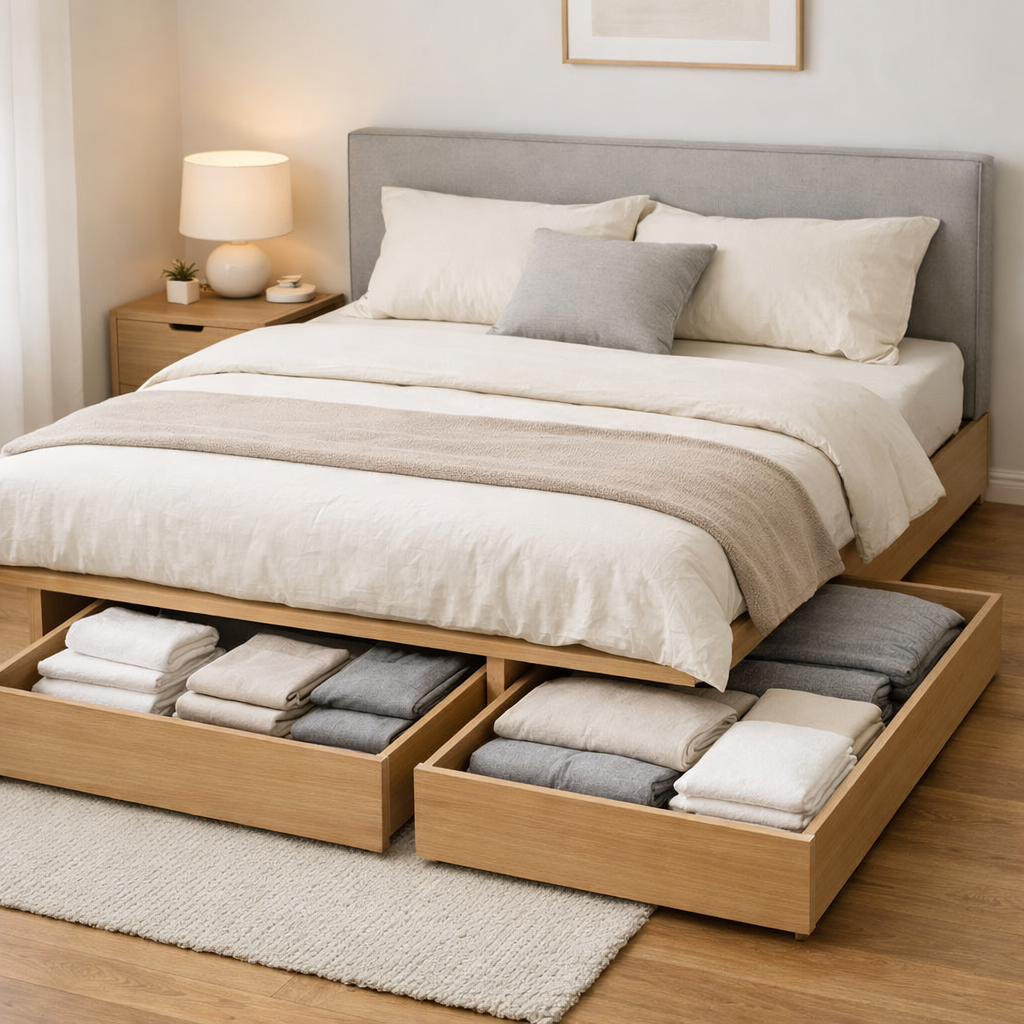
Seven Space-Saving Double Beds That Beat Drawer-Ottoman Combos
Small bedrooms demand smarter beds, not bulkier ones. While double beds that combine side drawers with an ottoman lift exist, they’re uncommon—and for good reason. Drawers need 28–32 inches of side clearance, while ottoman lifts add weight, complexity, and effort. Below, we profile seven double-bed types that beat drawer-ottoman combos on floor-space recovery, access, durability, and total cost—so couples can buy once and keep their aisles clear.
Strategic Overview
A space-saving double bed is any full-size sleeping solution that increases usable floor area, circulation, or storage without enlarging a room’s footprint. The best designs either reclaim the entire floor by day or consolidate deep, accessible storage beneath or beside the mattress—without compromising comfort or daily operation, as many couples now prefer.
Modern buyers are moving to designs that maximize floor area and operate smoothly under daily use, a shift highlighted in coverage of why couples are switching to wall beds that free space for work or play during the day (see this explainer on why many couples switch to wall beds). Drawer-ottoman hybrids ask too much of tight rooms: drawers require 28–32 inches of clear aisle for full extension, and ottoman lifts demand added weight and force to raise, especially with heavy mattresses—a mismatch confirmed by compact-room buying guides and storage-bed roundups that consistently stress clearance and mechanism quality.
Home Comfort Decisions
Our brand POV is simple: spec-first, safety-first. We help small-space dwellers and urban couples validate real-room fit before they buy—so returns go down and warranties stay intact.
What we verify:
- Mechanisms and materials: runners, hydraulics, pivots, certified wood, and low-VOC finishes
- Safety and fit: clearances, ceiling height, stud layout, and swing paths
- Policies and warranties: trials, returns, restocking fees, freight claims, and installation requirements
For deeper context, explore our storage beds coverage and small-space layout guides on Home Comfort Decisions. We consistently spotlight wall-bed systems that free daytime floor space and, when well designed, operate smoothly and quietly—key advantages for multi-use rooms.
Vertical Murphy / Wall Bed
A Murphy wall bed is a bed that pivots vertically into a wall-mounted cabinet, hiding as built-in furniture and instantly freeing the room’s floor. Quality counterbalance hardware makes the lift feel light and repeatable, and professional installation reduces long-term squeaks, racking, and undue wear (see this top space-saving bed overview and why many couples switch to wall beds). Home Comfort Decisions helps you confirm clearances and anchoring before you order.
Spec tips for couples:
- Ceiling height: confirm open height plus safe clearance for ceiling fans and soffits
- Structure: identify stud layout for anchoring; avoid weak partitions
- Mattress: verify thickness and weight limits with bedding included
- Swing path: ensure an unobstructed arc and safe landing zone
- Materials: prefer certified wood and low-VOC finishes for better indoor air
Comparison note: If you need an office or workout area by day, a Murphy solution often wins for full-room multifunctionality.
Horizontal Cabinet Murphy Bed
Cabinet-style or horizontal wall beds fold sideways, lowering overall height and solving conflicts with low ceilings, beams, windows, or fans while preserving that prized daytime floor clearance and fast deployment similar to vertical units. Our team can pre-check ceiling conflicts and hardware specs to avoid rework.
Measurement checklist:
- Cabinet depth in “closed” mode
- Projection when open (sofa, coffee table, or desk clearance)
- Handle height and reach for all users
- Aisles: target about 20 inches on one side and 12–16 inches on the other in tight rooms
- Hardware quality: look for balanced lifts and smooth damped motion; most units benefit from pro install to protect warranties and long-term alignment
Full-Depth Hydraulic Lift Platform
A hydraulic lift storage bed raises the entire mattress and deck on gas or hydraulic pistons to reveal a deep, dust-protected cavity beneath. Because there are no side drawers, you keep narrow aisles usable, and strong frames plus quality pistons have earned praise in independent testing for durability and ease of lift (see this best storage beds round-up and this storage-frame review compendium). We vet piston ratings against your mattress weight to keep lifts safe and light.
Why it beats drawers in small rooms:
- Zero side clearance needed for access
- One motion reveals a single large compartment (easier organization)
- Robust pistons and welded or well-braced frames handle daily use
Ergonomic specs:
- Top-of-mattress height: aim for 20–24 inches for easy sit-to-stand
- Weight check: add mattress, topper, and bedding, and keep within the lift’s rated capacity
- Choose lifts when furniture or door swings would block drawers
Deep-Drawer Platform Bed
When you have space to open drawers fully, deep-drawer platforms feel like a built-in dresser under the bed. We confirm aisle widths and runner load ratings so drawers open fully and track smoothly in tight rooms.
Smart setup:
- Clearance: reserve 28–32 inches on the drawer side so boxes extend fully
- Hardware: prioritize high-load, soft-close runners and thick drawer bottoms
- Materials: certified wood or lightweight steel frames with low-VOC finishes boost longevity and indoor air quality
- Budgeting: add-on under-bed drawers can be a notable line item—expect costs around a few hundred dollars per drawer in many market picks, so plan your total
Trundle or Slide-Out Second Bed
A trundle bed hides a second, lower mattress that slides out on casters or a sled when you host guests, then disappears when not in use—no permanent floor loss and no heavy lids to lift. It’s ideal for households that need occasional sleeping capacity over daily storage (see this small-space bed primer). We check underframe clearance and floor protection for smooth rollout on your flooring.
Key checks:
- Trundle clearance under the main frame
- Caster or sled mechanism type and floor protection
- Mattress thickness limits for the lower unit
- Avoid underframe obstructions (slats, supports) that snag the trundle
Tradeoff: You gain guest capacity but lose the deep storage volume of lifts or drawers.
Loft Bed with Workspace or Storage
Lofting a double mattress elevates sleep to create a full zone beneath for a desk, closet modules, or shelving—often multiplying usable square footage more than any drawer-ottoman hybrid, especially in studios and micro-apartments (see this space-saving bed overview). We model sit-up and ladder clearances to keep circulation safe.
Safety and fit:
- Ceiling height and sit-up clearance in bed
- Ladder orientation and safe landing zone
- Guardrail height and gap spacing
- Lighting plan: use dimmable 2700–3000K sconces; add rugs and curtains to absorb sound in open layouts
- Structure: prefer cross-bracing and, where allowed, secure wall anchoring to reduce sway
Daybed with Integrated Shelving
A daybed with storage functions as a sofa by day and a double bed by night, using drawers, cabinets, or built-in bookcases to reduce reliance on extra casegoods and ottoman compartments. It consolidates seating, sleeping, and storage in one footprint—great along a long wall in compact rooms (see this roundup of space-saving beds with shelving). We help balance sofa ergonomics with sleep comfort based on your mattress and layout.
Layout and spec notes:
- Place along the longest wall to preserve circulation
- Warm, dimmable 2700–3000K lighting supports evening wind-down; dense rugs and curtains help tame noise
- Confirm seat/bed depth, backrest height for sofa comfort, and mattress profile for day-night versatility
How we evaluated space savings and usability
We scored each option across floor-space recovery, accessible storage volume, clearance needs, mechanism complexity, and couple-friendliness. Wall beds demonstrably free the room for daytime use and, when designed well, operate smoothly; lift platforms offer excellent, easily accessed internal volume when pistons and frames are robust. This reflects Home Comfort Decisions’ spec-first evaluation approach.
| Bed type | Floor-space recovery (day) | Accessible storage volume | Clearance needs | Mechanism complexity | Couple-friendliness |
|---|---|---|---|---|---|
| Vertical Murphy / Wall Bed | Excellent | None (sleep only) | Front swing path | High | High |
| Horizontal Cabinet Murphy Bed | Excellent | None (sleep only) | Front swing path (lower) | High | High |
| Hydraulic Lift Platform | Good | Excellent (single cavity) | Minimal side clearance | Medium | High |
| Deep-Drawer Platform Bed | Fair | High (organized drawers) | 28–32 in on drawer side | Medium | Medium–High |
| Trundle / Slide-Out Second Bed | Good (guest flex) | Low | Side for pull-out length | Low–Medium | Medium |
| Loft Bed with Workspace | Excellent | Variable (under-zone) | Ladder and underzone paths | Medium | Medium–High |
| Daybed with Integrated Shelving | Good | Medium (drawers/shelves) | Shallow front access | Low–Medium | Medium–High |
Common failure points to avoid:
- Drawers: insufficient side clearance; cheap runners that rack or jam
- Lift beds: under-rated hydraulics or loose hinges
- Murphy beds: DIY installs on weak walls; poor alignment over time
Spec-first buying checklist for double beds in small rooms
- Mattress and size
- Confirm regional sizing; in 8×10 ft rooms, consider a European double (~140×200 cm) or short queen to protect aisles.
- Clearances
- Target 20 inches minimum on one side and 12–16 inches on the other.
- If using drawers, reserve 28–32 inches on the drawer side.
- Choose a hydraulic lift when aisles are tight or furniture blocks side access.
- Ergonomics and durability
- Top-of-mattress height: 20–24 inches for easy sit-stand.
- Favor reinforced mattress edges if you sit on the side.
- Specify certified wood and low-VOC finishes.
- Demand high-quality runners and robust hydraulic pistons with rated capacities to match your mattress and bedding.
Use Home Comfort Decisions’ pre-purchase checks to validate these specs before delivery.
Policy, delivery, and warranty considerations
- Policy review
- Check trial periods, return windows, restocking fees, and the process for freight damage; some premium storage beds advertise extended trials and even lifetime mechanism warranties, but terms vary widely across the market.
- Delivery planning
- Measure doors, stairs, and elevators; confirm threshold vs. white-glove service; photograph packaging on arrival for claims.
- Warranty alignment
- Verify coverage on hydraulics, runners, and pivots; many wall beds require professional installation to keep warranties valid and ensure safe anchoring.
Home Comfort Decisions can review terms and plan delivery paths to prevent avoidable claims.
B2B sourcing and landed-cost notes for small retailers
- Build a landed-cost worksheet
- Include unit price, MOQs, carton counts, dimensional weight, ocean/air freight, duties, last-mile fees, and assembly labor. Heavy lift hardware and wall-bed mechanisms raise DIM weight, shifting freight tiers.
- Mechanism and finish QC
- Cycle-test hydraulics and wall-bed pivots; load-test drawers and runners; verify low-VOC certificates; confirm spare-parts availability.
- After-sales readiness
- Stock common failure parts (runners, pistons), define RMA timelines, and negotiate extended mechanism warranties aligned with consumer expectations for storage beds.
Home Comfort Decisions helps retailers set QC protocols and landed-cost models grounded in mechanism specs.
Frequently asked questions
Are there double beds with both drawers and an ottoman lift?
Yes—combo designs exist but are uncommon because drawers need 28–32 inches of side clearance while lift bases add weight and complexity. Home Comfort Decisions generally recommends choosing one mechanism to reduce failure risk in tight rooms.
How do these options save more space than drawer-ottoman beds?
They either free the entire floor by day (Murphy), create a second zone below (loft), or provide deep, unobstructed storage with a single lift—avoiding aisle requirements and blocked access. We help you match the mechanism to your room so you actually regain usable space.
What mattress sizes and weights work best with lift or wall-bed mechanisms?
Stay within the maker’s weight rating for the mattress plus bedding; in 8×10 ft rooms, a European double (~140×200 cm) or short queen preserves aisles. Home Comfort Decisions can cross-check ratings with your mattress type for smooth operation.
What clearances and safety checks should I verify before purchasing?
Target 20 inches minimum on one side and 12–16 inches on the other; allow 28–32 inches on the drawer side. For wall beds, confirm ceiling height, stud anchoring, and swing path; for lifts, verify piston ratings—Home Comfort Decisions can pre-validate these to avoid returns.