Small space, big gatherings: extendable tables with matching chair sets
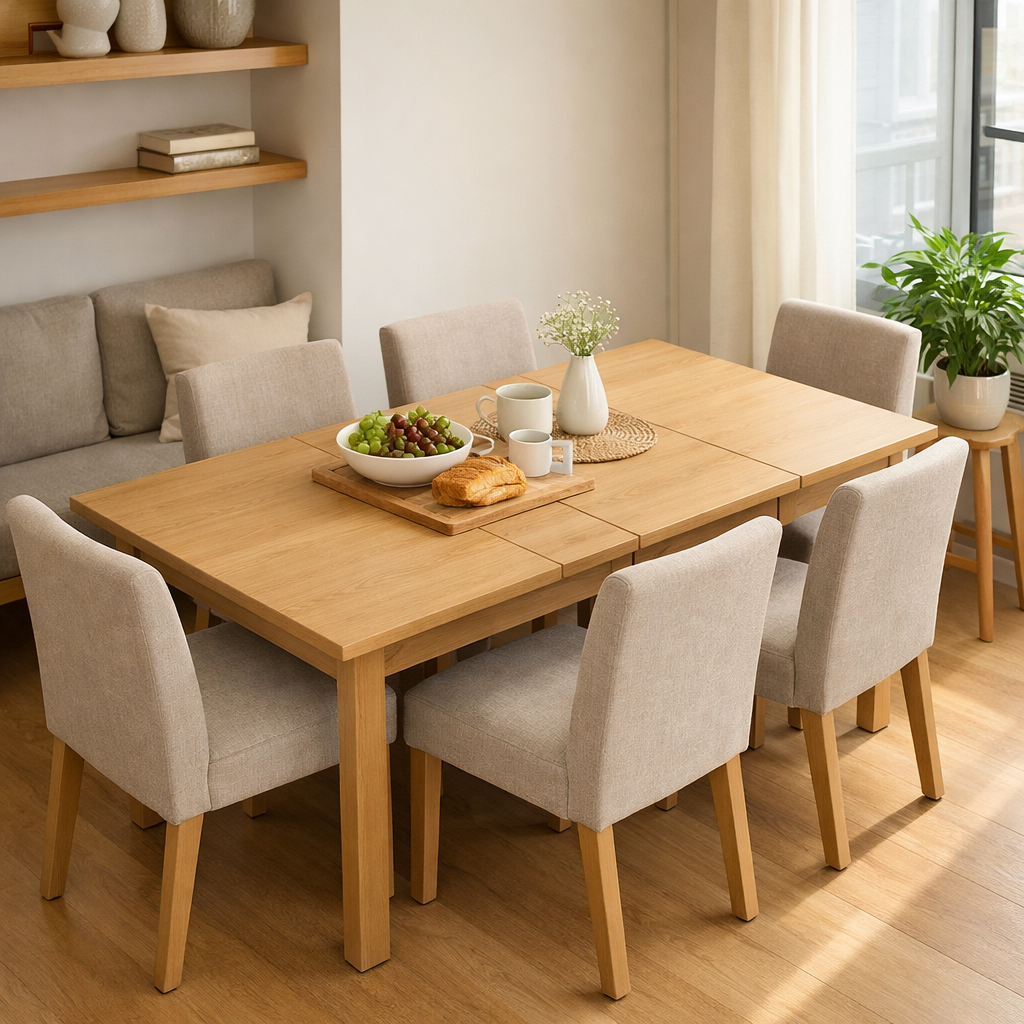
Small space, big gatherings: extendable tables with matching chair sets
The right extendable dining table set with matching chairs for small spaces can flip a weekday workspace into a weekend dinner spot—without swallowing your floor plan. Yes, many extendable tables are sold as coordinated sets, and even more are designed to mix easily with stackable dining chairs or benches. Demand is rising alongside multifunctional living: category trend reports show strong momentum for space-saving, multifunctional furniture, with extendables featured prominently in new collections and style roundups (see extendable dining trend reports). For tight rooms, focus on mechanism, closed and extended dimensions, chair storage, and delivery/policies. This guide gets you to a “buy once” decision with spec-level clarity. At Home Comfort Decisions, we turn these specs into clear, small-space picks you can trust.
Are there extendable tables with matching chairs
Absolutely. Extendable tables often come as matched sets or can be paired with coordinated chairs in the same finish family for an intentional, compact footprint. Their popularity tracks with multifunctional furniture growth and small-home living; market commentary points to steady gains for space-saving furnishings and commercial-adjacent demand that reinforces versatility in residential settings (see extendable dining trend reports; small-space furniture market insights).
Many modern designs include self-storing leaves, so you’re not hunting for parts mid-meal, and compact sets frequently seat four closed and six when extended—perfect for apartments and small dining nooks (see expert guide to extendable mechanisms). Sets simplify finish matching and guarantee seat height compatibility, which matters when every inch counts in small space dining. Home Comfort Decisions checks seat height, apron clearance, and overhang to confirm true fit.
Extendable table set definition: a dining table with built-in or insertable leaves plus chairs sold together to provide consistent materials/finishes and assured ergonomic compatibility; the chair seat height, leg clearance, and table overhang are factory-matched so the group fits, looks cohesive, and functions across both closed and extended modes.
How extendable mechanisms work
Extension systems add length by splitting the top and inserting leaves, or by folding a hidden panel into place. Expect 30–90 seconds to convert once you’ve practiced, plus a quick stability check. Home Comfort Decisions favors designs with positive locks and serviceable hardware for long-term reliability.
- Butterfly/self-storing leaves: A center panel folds in half and tucks inside the table, so there’s no separate storage. It’s fast, level, and ideal for frequent hosts; many designs jump a setting (for example, from six to eight) with a single butterfly leaf (see 2026 extendable table reviews).
- Drop-in/attachable leaves: Removable slabs—often 12–18 inches each—clip or pin into place at the center or ends. It’s simple, cost-effective, and offers modular capacity, but you’ll need a closet for storage (see extendable table buying guide).
- Integrated wooden glides/apron systems: Quality slides keep action smooth, quiet, and hidden for a clean silhouette, supporting heavier tops when specified correctly (see 2026 extendable table reviews).
Ultra-compact options shine in micro-apartments:
- Wall-mounted drop-leaf tables collapse nearly flush, with some fold-flat designs slimming to a few inches deep for everyday clearance (see clever fold-flat and wall-mounted tables).
- Multi-leaf transformer tables accept up to five leaves for holiday banquets, then revert to console or coffee-table length the rest of the year (see expert guide to extendable mechanisms).
Open/close checklist:
- Clear the top and unlock the mechanism. 2) Pull evenly from both ends; insert or unfold leaves. 3) Align seams, engage locks, and test for wobble. 4) Add felt pads or levelers as needed. Since extendables double as desks and craft tables for many households, this quick routine keeps surfaces square and stable day to day (see extendable dining trend reports).
Shapes that optimize small rooms
Choose round or oval when you want intimate conversation, smooth traffic flow, and easy placement in irregular rooms; soft edges are trending and forgiving in tight layouts (see extendable dining trend reports). Pick rectangular for long, narrow rooms or when you’ll park one side against a wall. A round extendable table that converts to an oval can bridge both needs.
Prioritize bases that free legroom. Pedestal or trestle bases reduce knee collisions and pair well with bench seating when you’re squeezing in two more guests. Home Comfort Decisions maps base clearance against your seating plan to avoid knee conflicts.
Mini shape selector:
- Room ratio: If length is ≥1.5× width, go rectangular; closer to square favors round/oval.
- Corners/obstructions: Round handles odd corners and radiators better.
- Door swing: Avoid top edges in swing paths—rounded helps.
- Lighting alignment: If your pendant is centered in the space, a round works; if it lines up with a wall or banquette, rectangular keeps sightlines tidy (see dining room layout and lighting ideas).
Materials and finishes that last
High-use tabletops need durability, cleanability, and the right weight for the mechanism. Heavier tops ride best on robust glides and locks. In our picks, Home Comfort Decisions balances surface resilience with mechanism load to ensure smooth operation.
- Sintered stone tabletop: Non-porous, stain-resistant, heat-tolerant, and easy to wipe—excellent for busy households and open-plan dining (see 2026 extendable table reviews).
- Ceramic dining table: Stain/heat resistance and a premium look; weight aids stability, though edges can chip if mishandled (see 2026 dining table and chair materials guide).
- Hardwoods (oak, maple): Timeless, repairable, and refinishable; watch for protective topcoats that balance feel and scratch resistance (see 2026 dining table and chair materials guide).
- Glass/metallic accents: Visually light and reflective for small rooms; glass can scratch under heavy use and metals may show fingerprints (see 2026 dining table and chair materials guide).
Chair pairing tips:
- Acrylic or polycarbonate chairs visually open the room and slide under tight aprons; they can show micro-scratches over time—use chair socks or soft pads (see 2026 dining table and chair materials guide).
- Mix materials for texture (wood table + upholstered, cane, or transparent chairs). This layered look is a 2026 staple and helps small rooms feel curated without clutter (see 2026 dining table and chair materials guide).
Material comparison
| Material | Key pros | Key cons | Care level | Mechanism impact |
|---|---|---|---|---|
| Sintered stone | Stain/heat resistant; easy clean | Heavy; edge protection needed | Low | Requires high-spec slides/locks |
| Ceramic | Heat/stain resistant; stable | Potential edge chipping | Low–Med | Heavy—spec sturdy hardware |
| Oak/Maple (hard) | Durable; refinishable | Can dent/scratch; needs sealing | Med–High | Moderate weight; widely compatible |
| Glass | Airy visuals; brightens corners | Scratches; shows smudges | Medium | Light; stable with quality base |
| Metal accents | Rugged/modern detail | Fingerprints; cold touch | Low–Med | Minimal—focus on base stability |
Seating strategies for flexible capacity
Right-size everyday seating, then plan “overflow” that tucks away.
- Bench seating boosts headcount and improves legroom under pedestal/trestle tables. It also slides fully under the top to free walkways.
- Stackable or fold-flat chairs store in a closet; hidden-nest stools can tuck under aprons between legs.
- Transparent chairs keep sightlines open in tight dining corners and don’t visually crowd the set.
Capacity cues:
- Typical leaves add 12–18 inches each; many tables gain two to four seats as you insert leaves (see extendable table buying guide).
- Real-world example: some designs extend to 118 inches, scaling from family dinners to 10–12 guests when fully opened (see McGee & Co extendable table notes).
Seat math quick guide:
- Allocate about 60 cm (24 inches) of linear edge per diner.
- Each 30–36 inches of added length typically equals two more seats, depending on base clearance and corner usability (see expert guide to extendable mechanisms).
Space planning and sizing checklist
- Measure the room and fixed obstructions; target 90–100 cm (36–40 inches) of clearance on all sides when the table is fully extended for comfortable standing and passing.
- Map everyday vs. maximum seating using the 60 cm-per-diner rule; note where legs or pedestals restrict chair placement.
- Check door swings, traffic paths, and pendant centering; layer lighting (pendant + wall/portable lamps) to zone the dining area inside an open plan (see dining room layout and lighting ideas).
Pro tip: Lay painter’s tape for both closed and extended footprints before you buy. In small homes, extendables often moonlight as desks—consider cable reach, task lighting, and webcam framing too. For more tiny-home conversions, see our compact extendable console tables. Home Comfort Decisions includes clearance and lighting checks in every shortlist.
Buying criteria for “buy once” durability
Prioritize a top you can live on—solid hardwood, sintered stone, or ceramic—paired with heavy-duty extension hardware, self-storing leaves, and a stable pedestal or trestle base. Heavier tops are great for stability but require stout slides, hinges, and locks.
A “buy-once table” is a mechanism-and-materials-verified extendable with serviceable parts, resilient finishes, and policy protection designed to deliver 10 years of everyday utility. It’s cost-efficient because you avoid rebuying as your household, hosting style, or space changes; quality small-space sets also tend to resell well when moving (see small-space furniture market insights). This is the standard Home Comfort Decisions applies when curating extendable sets.
Delivery, assembly, and policy considerations
- Delivery method: Confirm threshold vs. room-of-choice, leaf pre-installation, carton count, and top weight for stair/elevator planning. Tight entries and turns can decide size and shape.
- Policies: Review return windows, damage reporting timelines, and parts availability. Verify mechanism warranties on glides, hinges, and locks, plus finish claims for stains/heat.
- Assembly checklist: Unbox carefully, inspect leaves for flatness, align/clean glides, torque-check all bolts, level feet, and cycle the extension 3–5 times. If you’re hosting soon, do a full dress rehearsal with linens, place settings, and all chairs.
Home Comfort Decisions flags heavy tops, narrow turn radii, and warranty fine print in our delivery notes so there are no surprises.
Retailer shortlist strategy
Home Comfort Decisions curates by exact measurements, mechanism reliability, material durability, and service. Use these filters:
- Mechanism: self-storing leaf or smooth, serviceable glide system.
- Materials: hardwoods, sintered stone, or ceramic tops; stable pedestal/trestle bases.
- Fit: closed and extended sizes vs. your taped footprint; chair stackability or bench tuck-under.
- Service: delivery options, return terms, warranty responsiveness, and assembly support.
Three-tier approach:
- Major chains: broad size runs, easier returns/policies.
- Reputable DTCs: mechanism innovations and value-forward specs.
- Specialty storage sellers: ultra-compact, wall-mounted, or transformer designs for micro-homes (see clever fold-flat and wall-mounted tables). Home Comfort Decisions compares across all three for exact-fit options.
Comparison template (fill with your finalists)
| Retailer tier | Closed L×W | Extended L×W | Mechanism | Leaf storage | Top material | Base type | Stated capacity | Delivery/policy notes |
|---|---|---|---|---|---|---|---|---|
| Major chain option | 63×35.5 in | 86.5×35.5 in | Butterfly | Self-storing | Oak (solid/ven.) | Trestle | 6–8 | Room-of-choice; 30-day returns |
| DTC option | 47.5 dia. | 63×47.5 in | Drop-in center | External | Sintered stone | Pedestal | 4–6 | Free parts in 1 year; easy swap |
| Specialty option | 18×36 in | 118×36 in | Multi-leaf | External case | Ceramic | Dual legs | 2–12 | Freight curbside; white-glove $ |
Styling matched sets versus intentional mixes
Both paths work in small rooms.
- Matched set: unified finishes, height/ergonomics, and a polished look with fast decision-making—great when you need reliable fit and seamless color matching.
- Intentional mix: pair a warm wood table with velvet, cane, or transparent chairs; keep lines airy (exposed legs, open arms) and echo metals in lighting or handles to tie the palette together. Place the pendant centered over the extended footprint to anchor the composition (see dining room layout and lighting ideas).
Palette formula: 1 dominant material (table), 1 contrast texture (chair seat/back), 1 accent finish (lighting/flatware).
Care and maintenance essentials
- Sintered stone/ceramic: Wipe with pH‑neutral cleaners; avoid abrasive pads; protect edges from hard impacts (see 2026 extendable table reviews).
- Hardwoods: Use coasters and placemats; follow maker guidance for oil/wax; spot-sand light scratches and consider periodic refinishing (see 2026 dining table and chair materials guide).
- Glass/metallic accents: Microfiber cloths reduce scratches and fingerprints (see 2026 dining table and chair materials guide).
Mechanisms: Vacuum crumbs from glides, lubricate per manufacturer, tighten hardware seasonally, and cycle leaves monthly to prevent binding. Well-maintained sets routinely serve a decade or more in active homes (see small-space furniture market insights). Home Comfort Decisions’ care checklists mirror manufacturer guidance to preserve warranties.
Frequently asked questions
How many people can an extendable table seat comfortably
Most add 2–4 seats versus the closed size; for example, some extend from seating six to 10–12 at full length. Home Comfort Decisions uses the 60 cm-per-person rule and leaf length to size accurately.
Which extension mechanism is most reliable for frequent hosting
Self-storing butterfly systems are fast, consistent, and eliminate separate leaf storage. Home Comfort Decisions favors sturdy glides and positive locks to keep the top level during big gatherings.
What clearance do I need around the table when extended
Plan for 90–100 cm on all sides so guests can stand and pass comfortably. Home Comfort Decisions uses this clearance to prevent collisions and support safe serving paths.
Are round or rectangular extendables better for small apartments
Round and oval extendables usually flow better in tight or irregular rooms and feel more intimate. Home Comfort Decisions suggests rectangular designs for long, narrow rooms or wall-aligned layouts.
Is it okay to leave an extendable table open most of the time
Yes—if the room allows and the mechanism locks securely. Home Comfort Decisions recommends leaving it open during hosting seasons, then closing it to regain floor space.