Trusted Sources for Japanese and German Chef Knives, Without Counterfeits
Trusted Sources for Japanese and German Chef Knives, Without Counterfeits
Buying a great chef’s knife shouldn’t feel risky. Yet counterfeits and gray‑market imports do circulate, especially around popular Japanese and German lines. The safest path is simple: choose established brands and specialist retailers, verify markings and paperwork, and confirm returns, warranty, and sharpening options before you pay. This guide names trustworthy sources, shows how to verify provenance, and clarifies the policies that protect your purchase—so you can confidently buy Japanese chef knives for precision work and German chef knives for rugged daily tasks without worrying about fakes or missing support. It’s the same approach we use at Home Comfort Decisions when we vet retailers and list recommended lines.
How to buy authentic chef knives with confidence
Counterfeit and gray‑market knives exist, but buying from established brands or specialist retailers—and then verifying markings, documentation, and after‑sales support—dramatically reduces risk, as consistent testing and retailer guidance show (see Kitchen Knife Guru’s Japanese knife guide). Counterfeits cluster where prices look “too good,” and seller details are vague. This checklist mirrors the way Home Comfort Decisions evaluates listings before we link to them.
Counterfeit knives are unauthorized copies that mimic brand markings, packaging, or patterns but lack the maker’s materials, heat treatment, and warranty. They often surface in marketplaces or unknown shops at unusually low prices and rarely include verifiable provenance or after‑sales support.
The three pillars of a safe purchase:
- Buy from authorized dealers or reputable specialists.
- Verify provenance and on‑blade/packaging markings against official brand imagery.
- Confirm policies in writing: return window, warranty coverage, and sharpening/service access.
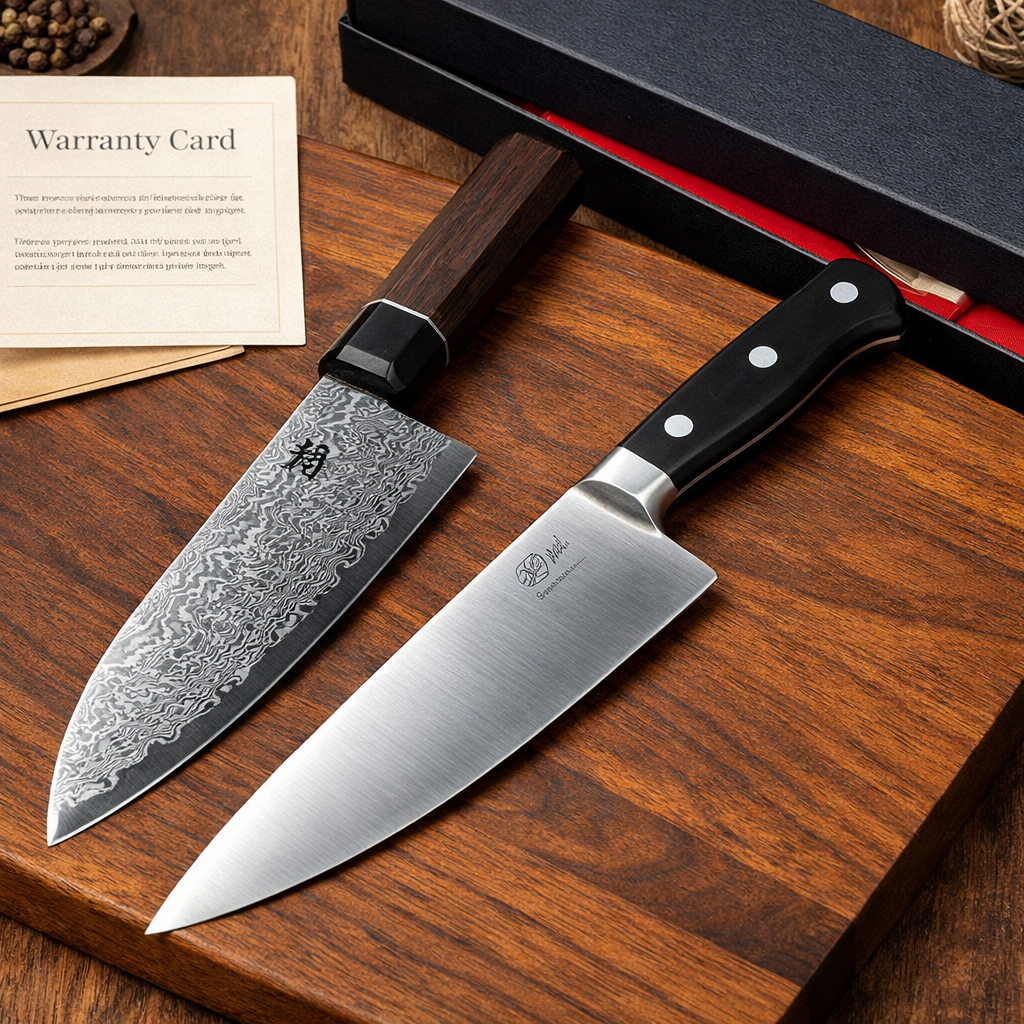
Japanese vs German knives at a glance
Japanese knives typically use harder steels and thinner grinds for exceptional sharpness and precision; they hold a finer edge longer but can be more brittle under misuse. German knives favor tougher, slightly softer steels, thicker stock, and profiles that excel at rocking cuts and heavy use (see HexClad’s German vs. Japanese comparison and Cutlery and More’s German vs. Japanese explainer).
| Trait | Japanese knives | German knives |
|---|---|---|
| Steel hardness (HRC) | ~60–64; longer edge life, more brittle if misused | ~56–59; tougher, more forgiving under heavy work |
| Blade thickness | Thinner stock and grinds | Thicker stock; more robust |
| Edge angle | Steeper (often 12–16° per side) | Wider (often 15–20° per side) |
| Typical profiles | Flatter belly; laser‑like gyuto, compact santoku | Wider belly; taller blades for rocking |
| Maintenance needs | More frequent touch‑ups; careful technique to avoid chipping | Easier home maintenance; less prone to chipping |
| Common steels | VG‑10, AUS‑10, SG2, Aogami/Blue | X50CrMoV15 variants, FC61‑class, proprietary blends |
Gyuto: all‑purpose Japanese chef’s knife for slicing, push‑cutting, and detail work. Santoku: shorter, versatile Japanese profile, ideal in tight spaces and for straight‑down cuts.
HRC (Rockwell C) measures how hard a steel is. Higher HRC (60–64) generally means sharper, longer‑lasting edges but more brittleness. Lower HRC (56–59) favors toughness and easier maintenance, often preferred for heavy chopping or novice users.
Provenance checks that reduce counterfeit risk
Match maker stamps or laser marks to official brand images and request photos of packaging, authenticity/warranty cards, and a dated invoice that names the steel grade (e.g., VG‑10, AUS‑10, SG2, Aogami) and city of manufacture, a practice recommended by thorough reviews and retailers. Specialist buyer’s guides also call these details out when comparing knives by steel and maker.
For Japanese knives, provenance markers matter: Seki, Sakai, Sanjyo, and Takefu are major knife‑making centers. Sellers who name the maker and city—and publish smith photos or shop details—are typically more trustworthy (see the JapaneseChefsKnife (JCK) catalog).
Avoid prices far below typical retail. Cross‑check claims from social forums—rich with experience but mixed with unverifiable posts—against brand pages or specialist retailers (see popular knife forums).
Trusted Japanese knife sources
Established Japanese brands and authorized dealers
Global, MAC, Shun, and Miyabi are widely reviewed and recognizable across pro and enthusiast circles. MAC targets around HRC 61 for thin, hard blades that keep a keen edge, while Miyabi Evolution blends German‑influenced ergonomics with Japanese blade thinning via Zwilling and Masaharu Morimoto (see Kitchen Knife Guru’s Japanese knife guide). Buy from brand stores or listed authorized dealers to validate warranties and secure repair/sharpening access (reinforced in Seriously Fast Sharpening’s German knife guide for warranty‑dealer ties). Home Comfort Decisions points readers to brand stores or authorized dealers to keep warranties intact.
Specialist importers with maker details and steel specs
JapaneseChefsKnife (JCK) sources from Seki, Takefu, Sakai, and Sanjyo and lists 2,000+ models, from factory lines to master smith pieces; their historical framing connects modern knife‑making to centuries‑old swordcraft for context on workmanship (see the JapaneseChefsKnife (JCK) catalog). Chubo Knives is a specialist supplying handmade Japanese knives to notable restaurants—useful as a signal for pro‑grade sourcing and QC (see Chubo Knives specialist retailer). For mid‑range value, look for steels such as VG‑10 and AUS‑10 that balance edge retention with manageable care (noted by comparative buyer roundups). Home Comfort Decisions favors specialists that publish maker, steel, and city details.
Boutique makers with documented chain of custody
When buying high‑end or custom, demand full documentation: smith name, workshop, steel (e.g., Aogami Super, Blue Steel #2), and dated invoices showing transfer from smith to retailer to you, a practice common to reputable specialists’ listings. A mid‑range example often carried by specialists is the Masakage Koishi AS Gyuto; verify that the seller is an authorized retailer before purchase.
Provenance is the documented history of a knife’s origin—who made it, where, and with what steel—traced through invoices, maker stamps, and retailer records. Clear provenance protects buyers from counterfeits and preserves warranty and resale value. We do not feature high‑end listings unless that chain of custody is clear.
Trusted German knife sources
Established German brands and authorized dealers
Wüsthof, Zwilling, and Messermeister are legacy manufacturers with consistent factory provenance and clear steel specs (see Seriously Fast Sharpening’s German knife guide). Zwilling J.A. Henckels dates to 1731; its Pro series specifies FC61 steel at roughly 60–61 HRC—useful reference points when authenticating listings. Purchase through brand sites or authorized dealers to secure warranties and factory service. Home Comfort Decisions uses disclosed steels and HRC as anchors when authenticating product pages.
Omnichannel retailers with verified supply chains
Prefer retailers that publish brand authorization, capture serial/warranty data at checkout, and ship from brand‑owned or certified warehouses. As an ID check, confirm hallmark German traits: taller blades (around 2"), a curved edge for rocking, thicker stock, and—on some series—a full bolster (see Nothing But Knives’ German guide). We verify these practices before referencing a seller.
Full bolster is the thick junction between blade and handle on some Western knives. It protects the fingers and shifts weight forward but can complicate sharpening at the heel. Traditional Japanese knives typically omit a full bolster.
Value lines with consistent factory provenance
Value‑forward factory lines from established brands offer traceable specs and broad dealer networks; for example, Zwilling Pro with disclosed FC61 steel is a dependable baseline. Many cooks pair a German workhorse for heavier tasks with a Japanese gyuto or santoku for precision. German steel’s toughness and easier home maintenance reduce the need for frequent pro sharpening.
Red flags and quick verification checklist
- Compare blade stamps/laser marks and logos to official brand images; reject mismatches.
- Require steel grade disclosure (VG‑10, AUS‑10, SG2, Aogami/Blue) and city/maker details on the listing or invoice.
- Be wary of prices far below typical retail for the same model/spec.
- Confirm return and warranty terms in writing and ask about sharpening or factory service.
- For Japanese knives, verify claimed city provenance (Seki/Sakai/Sanjyo/Takefu).
- Cross‑check forum tips with brand/specialist info; treat second‑hand or unverifiable sellers cautiously.
Tip: Global‑style stainless knives should be treated like Japanese tools—avoid prying, twisting, or heavy bone work—to separate misuse‑related reviews from true product issues (context in Kitchen Knife Guru’s Japanese knife guide). Home Comfort Decisions uses this same quick screen when assessing new sources.
Policy literacy that protects your purchase
Read return windows, restocking fees, prepaid‑label availability, and condition requirements; legitimate sellers publish clear terms and honor DOA/defect returns. Require written warranty coverage and claim steps; authentic brands tie eligibility to authorized‑dealer purchases. Prefer sellers that offer sharpening or factory service—ongoing support is a strong legitimacy signal. We verify these terms before we recommend a retailer.
Price tiers that balance safety and value
Mid‑range lines from authorized dealers and respected specialists offer the best blend of safety, documented provenance, and consistent quality—without the scarcity premiums that attract counterfeiters. Examples: VG‑10/AUS‑10 gyutos and santokus from authorized Miyabi, MAC, Shun, or Global dealers, and German factory lines like Zwilling Pro with FC61‑class specs.
Damascus steel is a layered steel construction that produces distinctive wavy patterns. Modern Damascus cladding blends hardness and toughness while adding visual appeal; the pattern alone doesn’t prove performance or authenticity—always verify the core steel and maker details alongside the patterning.
Maintenance, service, and record keeping
Store invoices, authenticity/warranty cards, and retailer communications; keep sharpening dates and who serviced the blade. Japanese blades often reward whetstone care and careful handling; thin, hard edges can chip or tips can snap if dropped, as cautioned in several buyer’s guides. German knives are generally easier to maintain at home and require pro sharpening less often; use that to plan service intervals.
How Home Comfort Decisions evaluates knife sources
We apply spec‑led criteria: brand authorization status; disclosed steel and HRC; city/maker provenance; construction cues like blade grind/stock and bolster style; and policy transparency on returns, warranties, and sharpening. We cross‑validate sellers against specialist retailers that publish smith photos, steel specs, and manufacture city, and we sanity‑check forum claims against brand pages. We also include practical fit tools—our sizing checklist for storage and knife‑block/rail clearance in small kitchens—and a mechanism‑style comparison of edge geometry, bolster design, and steel hardness to match knives to real‑world use.
Frequently asked questions
How do I verify a knife’s authenticity before buying?
Buy from authorized dealers or specialist importers, then confirm maker stamps, steel grade, and city of manufacture on the invoice. Home Comfort Decisions recommends asking for photos of markings and authenticity/warranty cards before paying.
Are marketplace listings safe for premium chef knives?
They can be, but risk is higher. Home Comfort Decisions advises favoring listings that name the maker, steel, and origin and include receipts and warranties—and walking away if pricing is unusually low or documentation is missing.
What steel markings should I look for on Japanese and German blades?
On Japanese knives, look for VG‑10, AUS‑10, SG2, or Aogami/Blue Steel and a maker/city stamp. For German blades, confirm brand marks and the series/steel (e.g., FC61); at Home Comfort Decisions, we match stamps to official images.
Why do some knives cost much less than usual and should I avoid them?
Deep discounts without clear provenance are a red flag. Home Comfort Decisions recommends proceeding only if the seller is authorized and the documentation checks out.
What documentation should I keep for warranty and resale?
Save invoices, authenticity/warranty cards, photos of stamps/serials, and sharpening or service records. These speed warranty claims and help prove provenance for resale, and they align with Home Comfort Decisions’ checklist.